

When Education is Designed for Good Jobs and Real Lives, Opportunity for Everyone Expands
April 28, 2026 | College Futures Foundation
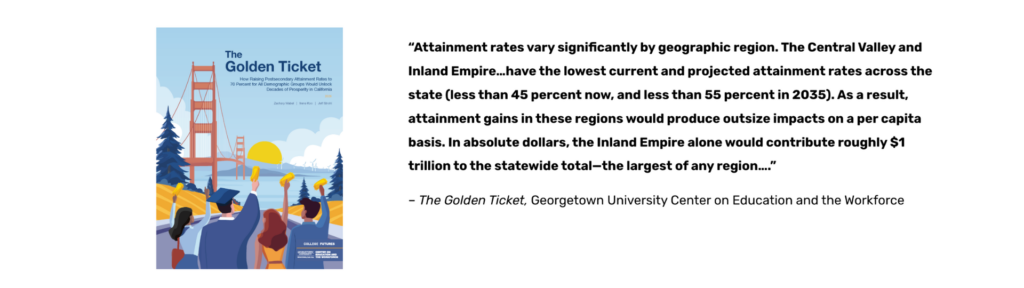
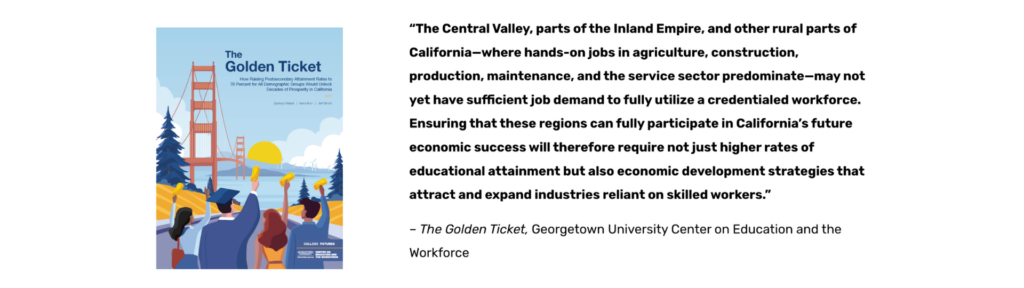
Findings from The Golden Ticket report reinforce a central truth: increasing attainment is necessary, but on its own it is not enough. Without clear pathways to good jobs and economic mobility, it cannot deliver the value learners and communities need and deserve. Closing this gap requires a clear understanding of regional economies—where quality jobs exist, the skills they demand, and who can access them—and a deliberate alignment of postsecondary pathways to meet those conditions. Today, the cost of that misalignment is evident across California and beyond: employers look outside their regions to fill critical roles, while local talent remains disconnected from opportunity.
In California’s Coachella Valley, a growing coalition of employers, educators, and community leaders is working to better align education with opportunity. By starting with employers and working backward, they are reshaping pathways so more residents can complete postsecondary education and move into jobs that offer real upward mobility.
Michele Finney began her career forty years ago at a hospital in the Coachella Valley, working in the dietary department.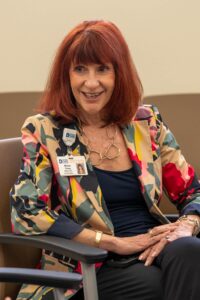
She moved across roles and eventually became an assistant administrator. When the position changed to require a master’s degree, she returned to school while continuing to work full time. Her employer covered the cost.
She recalls of that time: “It’s hard work. I went to school full-time while I was working full-time, but it was definitely worth it.”
Finney is now the Executive Chairwoman of Desert Care, a network of several hospitals serving the region. The reality she faces is different. The pathways that once shaped her own career are less accessible, part of a broader set of challenges that have led to persistent shortages of healthcare workers, especially nurses.
Healthcare is now one of the fastest-growing industries in the Coachella Valley. The population is older and much of the region’s healthcare workforce is nearing retirement, creating a steady need to replace workers.
The problem came to a head during the pandemic, when healthcare professionals left to care for family members, training of new nurses slowed, and others left the field permanently. To fill the gap, Finney, along with other hospital executives in the region, was relying on hundreds of traveling nurses each year. Regions across the country were also competing for those same nurses.
“[It’s] very expensive to reach out to those temporary resources,” says Finney.
Having a more stable workforce is as much a clinical strategy as it is a financial one. “The retention of your workforce in healthcare is highly valued,” Finney says. “It allows you to provide high quality care and continuity of care.”
During this time, Finney joined hospital executives and regional partners as part of a convening hosted by OneFuture Coachella Valley (OneFuture), a local community-based organization, to identify and develop solutions.
“Through conversations with OneFuture, we identified that the need for healthcare workers was strong and the forecast was continuing to show that there would be a workforce shortage,” says Finney of initial conversations with the group.
The limits of relying on outside talent became clear, pointing to a different solution: create a workforce closer to home.
To do that, the group—comprised of the education system, the workforce system, the payer-provider system, and the healthcare district—resolved to put their separate interests aside and unify around the needs of students entering the healthcare field.
“Even if we were competitors with each other, we had to place that aside and ground ourselves around student[s], to encourage learners to enter into healthcare and to grow, get educated, and be successful,” says Finney.
The group looked across the entire system for points of intervention. For Finney, that meant hospitals taking a more active role: “identifying individuals entering college, supporting them through training, involving them in clinical rotations, and introducing them to the hospital environment.”
To do this, the group started conversations with administrators at College of the Desert, which was turning away nursing applicants every year due to a lack of capacity. Eventually the group pooled resources, including a $3.4 million fund, to expand the nursing program at College of the Desert.
At the center of the effort to supply more local nurses is Sarah Fry, Director of Nursing at College of the Desert.
Her work sits at the intersection of education and employment systems. On one end, students arrive with ambition, but also with jobs, families, and financial pressures that make sustained training difficult. On the other end, local employers like Michele Finney need a steady pipeline of nurses prepared to step into complex, high-stakes roles.
During the pandemic, the gaps between those systems became more visible. College of the Desert was turning away qualified nursing applicants the region needed. The school had been approved to increase its enrollment, but did not have enough instructors, clinical placements, or space to accommodate more students.
With the additional resources provided by local partners, College of the Desert brought on additional faculty, expanded its facilities, and converted existing classrooms into skills labs that mirror hospital environments.
Even with more resources, however, another issue was preoccupying the group.
She and her team asked, “why do we start with 35, but maybe only end with 30?”
As a former nurse, Fry understands firsthand what it takes. Nursing school, she says, “requires a support system.” Many of her students are working learners, managing children, caring for aging parents, holding full-time jobs, and navigating financial strain.
In response, partners like OneFuture began building support around the nursing program itself. Students were connected to mentors and counselors, and received help with financial planning, basic needs, and other forms of support that would give them a better chance of persisting through a demanding program. “The resources allow students to focus on becoming a nurse rather than, ‘How am I going to put food on the table? How am I going to provide shelter for my family? How am I going to purchase clothes or diapers for my baby?’” says Fry.
At the same time, employers became more directly involved, providing clinical placements, helping shape training, and investing early in the students they would eventually hire.
Fry shares, “we’ve created a model where education and healthcare grow hand in hand.”
In May, the newly expanded program will graduate 100 nurses. For many of those students, the impact will be life changing. Their new roles will significantly increase their earnings, in some cases tripling their income, and doing so without the burden of significant debt.
Among those preparing to graduate from the program is Maritza Avila, a forty-six-year-old former veterinary technician.
For more than a decade, Avila built a steady career working at a family-run veterinary clinic. Then, in the span of a few years, her marriage ended, the clinic was sold, and her mother became ill. She began to wonder how she could support herself on a single income and care for her aging mother. She could see clearly that none of this would be possible working as a vet tech.
When she was accepted into the nursing program, she cried.
“I really didn’t think I was going to get in,” she says. “I felt like I won the lottery.”
Prior to enrolling in the College of the Desert expanded RN program, Maritza took night classes while continuing to work ten-hour shifts, enrolling in one or two courses at a time. When she began considering programs, she focused on finding one that would allow her to continue working, remain close to her mother, and avoid taking on significant debt.
Having been out of school for more than twenty years, she felt even more weight in her decision.
“There was a lot of insecurity,” she says. “I didn’t even have a laptop when I started the nursing program.”
In class, however, she found she was not alone. Many of her peers were navigating similar responsibilities and returning to school after years, sometimes decades, away.
“The older students, we’re dedicated. We’re going back and having all this responsibility and still taking time to sit in a class or do homework. And I think that’s unseen.”
In her first semester, the director of the program urged Avila and her classmates to apply for a scholarship through OneFuture.
“I didn’t realize at the time how much of an impact OneFuture had on my nursing program.”
Beyond scholarships, Maritza and other learners received comprehensive support through OneFuture, including access to mental health services, help navigating food assistance and other benefits, and ongoing guidance from mentors and coaches.
This May, Avila is preparing to graduate and has begun applying for jobs at several of the local hospitals, eager to start her next chapter.
“Until I see that first paycheck, I think that’s when things are going to be really changing for me,” she says.
She adds, “It’s amazing what just these last two years have allowed me to do. And I really feel proud.”

The difference is in designing around and with people like Maritza Avila and Michele Finney. This is the aim of OneFuture Coachella Valley: to better align education with the needs of the regional economy and the people within it.
OneFuture began as an arm of the local economic development agency. Sheila Thornton, President and CEO of OneFuture, says the effort centered on doing things differently to achieve different results, especially “for students in the region who have too often been behind.”
Since 2005, Thornton and her colleagues have worked in the Desert region to ensure that local students, particularly those underrepresented in postsecondary education and high-wage careers, have access to opportunity across their entire educational pathway, including into good jobs.
What’s emerging in the Coachella Valley is a shift from disconnected systems to a coordinated regional approach where education and employment are designed together. Rather than beginning with education alone, OneFuture anchors its model in the realities of the regional economy. As Thornton explains, OneFuture and its partners “work backwards from the jobs that exist and look at whether or not local students get into those jobs, and then whether or not they have the education, financial support, and network to step into those pathways.”
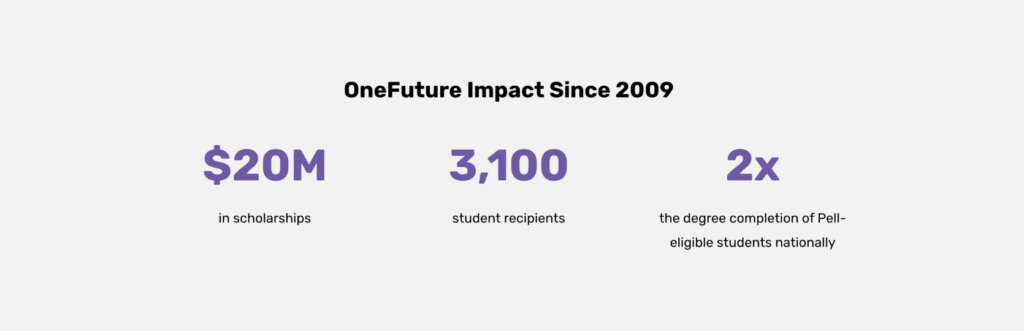
Among the thousands of degrees completed by OneFuture learners, 40 percent are in healthcare. Those graduates are also being hired locally, demonstrating the impact of aligning education with sector needs.
“We have alleviated a significant workforce issue in the Coachella Valley,” says Thornton, “primarily from the lens of giving local students the opportunity to get into those jobs that they would otherwise not have been prepared for.”
What that takes, Thornton emphasizes, is “developing a common understanding of what is in it for every sector, for every group, focusing together on the outcome of the student, of that [of the] learner.”